Future Technology Now: Microsoft talks about Intelligent Systems
Kevin Lan
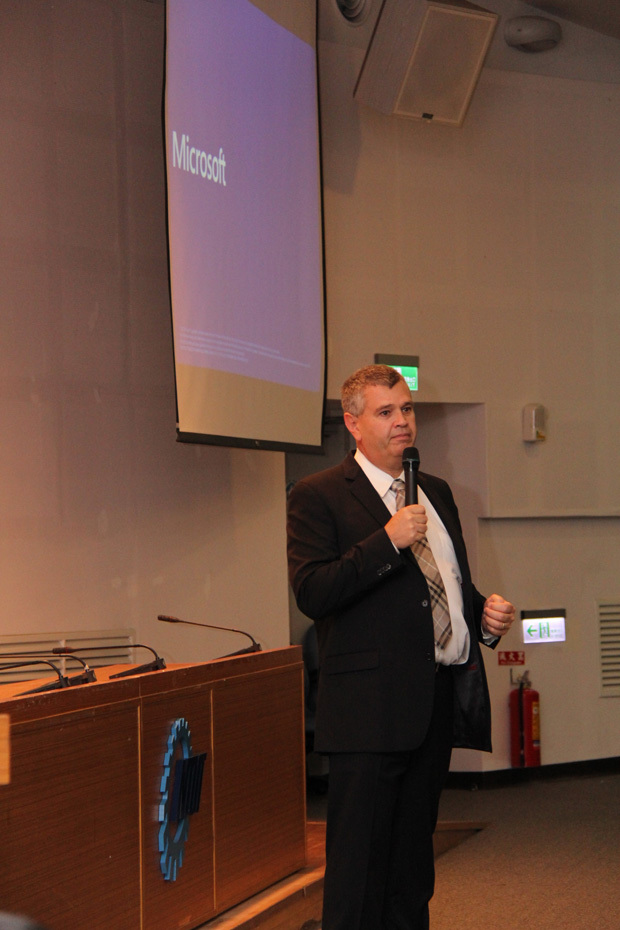
The students of Taipei Tech were honored to have Microsoft OEM General Manager Mr. Murray Vince back again for another speech this year. This time, Murray wanted to inform us on one specific area of growth in the industry: intelligent systems.
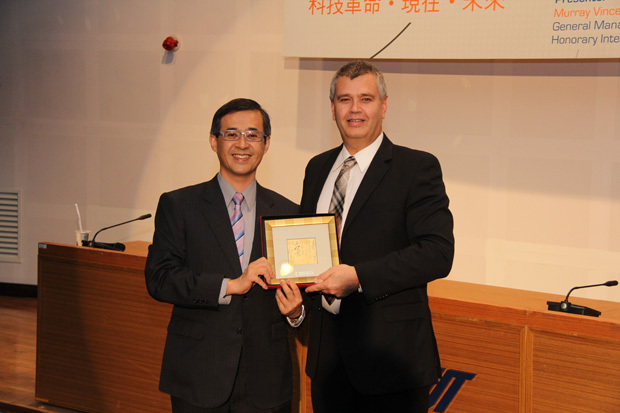
Before the speech begins, a short film on the imagination of future with intelligent systems impressed the audience with its wonderful experiences shown in the film. Joined with the President of Taipei Tech, Yao and the General Manager of Microsoft Taiwan, Mr. Wu, Mr. Murray was pleased to re-visit our university with another speech.
Useful statistics of the market momentum was informed by Mr. Murray after a brief introduction of the intelligent systems. The growth of Smartphones and embedded systems will make an impact on the market of intelligent systems, and by 2016 it will be two times larger than the current market size. Mr. Murray suggested that the numbers are significantly influential to the future of technology. To show the importance, he showed the audience how this area of industry has been progressing, and is already being taken into consideration by Microsoft and its partners. A clip of experiences shared by various partners of Microsoft, like the Ford, expressed how the Microsoft Windows Embedded systems facilitate their performance and production. In addition, to give us an idea on how this Microsoft intelligent system can be used on a personal level, Mr. Murray showed a clip on how a traveler could spend his vacation with the assistance of intelligent systems. For example, the traveler could check-in to his hotel with his Smartphone at the airport, all in the meanwhile the computer notifies the hotel manager to prepare the room according to the traveler’s preset preferences. In the third video clip, it gave us an example on how intelligent system can be used to assist with manufacturing. Kuka, one of the companies that employ Microsoft Windows Embedded, uses their robots to manufacture Jeeps with the help of intelligent systems. Their increase in efficiency was achieved through the combination of 246 robots, 36 processers and the instant data management within their office.
To develop a smooth intelligent system, Murray pointed out some elements: connectivity, security, identity, manageability, user experience and analytics. Servers and data centers are thus important. Jesse Lin from Microsoft Taipei demonstrated how the speed of the Microsoft servers has been enhanced. Murray also informed the improvement of the data centers through the many different generations. With the concrete data centers and more than 200 online services, customers can easily get the results in fraction of a second through a secured-reliable service.
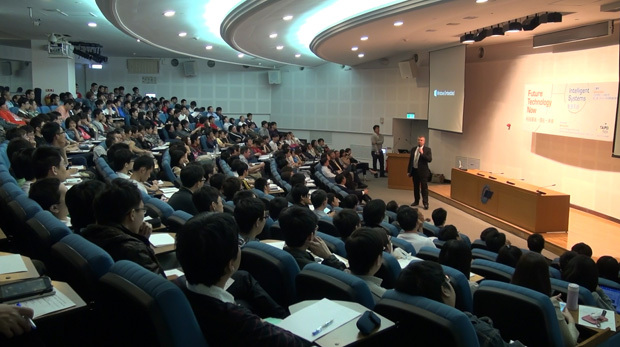
To prepare for the future, Murray reminded us to ask ourselves what aspect of intelligent system coincides with our specialty, and our versatility for cross-discipline will add to our resume. During Q&A time, he also encouraged the students who does not major in IT to keep an open mind and study other disciplines. Companies like Microsoft employ talented people in all fields that excel at what they do. Murray gave some advice to a civil engineering students; he suggested “If you are a civil engineer learn a little bit about intelligent system and connectivity it will helps you in your own job.” He encouraged people from different fields to contribute and build the growing industry of intelligent systems together with Microsoft.
At the end of the speech, Murray happily answered questions from Taipei Tech students and took pictures with everyone. Lastly, in the interview with Mr. Murray, he indicated that there are many partners of Microsoft in Taiwan, including 7-Eleven, the Taipei Metro and the ATM systems. This implied that the devices and the services illustrated in the speech have already been in use by Microsoft. “We do little things every day. We do the big thing to make sure the little thing works” said Mr. Murray. Microsoft doesn’t manufacture, but they enabled people to do.