Taipei Tech Reaches No. 4 in NATURE Research Ranking Among Taiwan Peers
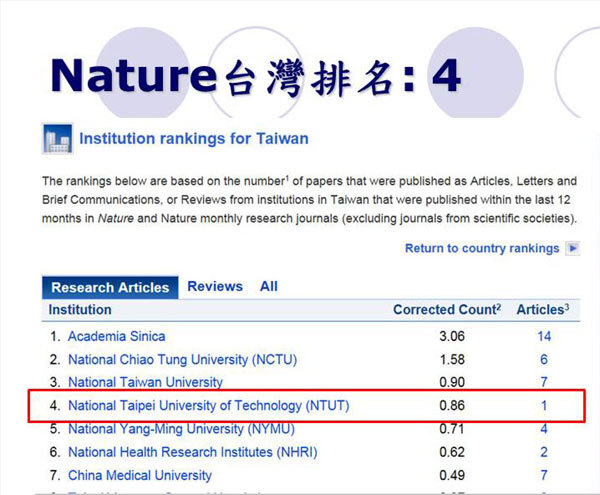
Source: Nature Asia-Pacific website (April 23, 2012)
A research team led by Prof. Yi-Jun Jen of the Department of Electro-optical Engineering published their study in Nature Communications (Volume: 2, 21 June 2011). The paper also raised the institution ranking of Taipei Tech to corrected count 0.86 /article 1. The rankings are based on the number of papers that were published as Articles, Letters and Brief Communications, or Reviews from institutions in Taiwan that were published within the last 12 months in Nature and Nature monthly research journals.
Waveplates are critical optical components in most optical system. However, for many applications including CD and DVD storage and displays, the waveplate needs to control the polarization state without dependence on wavelength in the intensity of emerging light. Therefore an achromatic waveplate is indispensable in both scientific research and commercial applications. The research was inspired by the microvillar structure of R8 cells functioning as polarization converters in the eyes of stomatopod crustaceans.
The team designed and tested periodically multilayered structures comprised of two different types of arrays of nanorods, morphologically analogous to the ocular cells. They found that the periodically multilayered structures can function as achromatic waveplates over the visible regime.
Prof. Yi-Jun Jen is Professor and Chair of the Department of Electro-optical Engineering. He joined the Department of Electro-optical Engineering, Taipei Tech in 2002. His current research interests are the fabrication of nano-sculptured thin films, novel optical devices development with multilayer design and deposition, anisotropic optical analysis and measurements for nano-scale composite materials.
The full list of authors are: Yi-Jun Jen, Akhlesh Lakhtakia, Ching-Wei Yu, Chia-Feng Lin, Meng-Jie Lin, Shih-Hao Wang and Jyun-Rong Lai.
The article is entitled “Biologically inspired achromatic waveplates for visible light” and can be found at : http://www.nature.com/ncomms/journal/v2/n6/full/ncomms1358.html