Taipei Tech Takes Another Step Towards Solving the Energy Crisis
By Rebecca Lynn Li
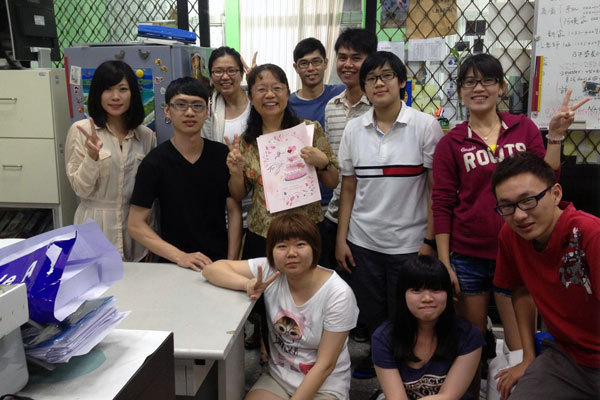
Director of Molecular Science and Engineering Department, Professor Su and her team of graduate students
As the numbers on the electronic tag lit up, there was a hush of disbelief and then a wave of excitement broke out among the students in the laboratory located at the highest floor of the Molecular Science and Engineering Building in Taipei Tech. The team of students in the solar cell education program had just successfully powered an electronic tag using solar cell technology. They did it with indoor light, however, not sunlight.
Led by Professor Chaochin Su (蘇昭瑾), a team of graduate students in the Molecular Science and Engineering Department constructed a Dye Sensitized Solar Cell (DSSC) Module which could power an electronic tag using just indoor light. When a light source gives enough energy to dye molecules in DSSC, they become excited. The electrons from the dye molecules are then injected into the anode electrode. The electrons then pass through the circuit and reduce the previously oxidized dye molecules, which creates a continuous electric cycle. Several DSSCs are connected in series or in parallel to construct the DSSC module, which has an increased voltage or current capable of powering the electronic tag. The success of the researchers at Taipei Tech meant another step is taken towards achieving the eventual goal that all green energy researchers want to achieve: the ability to power everyday objects with renewable energy.
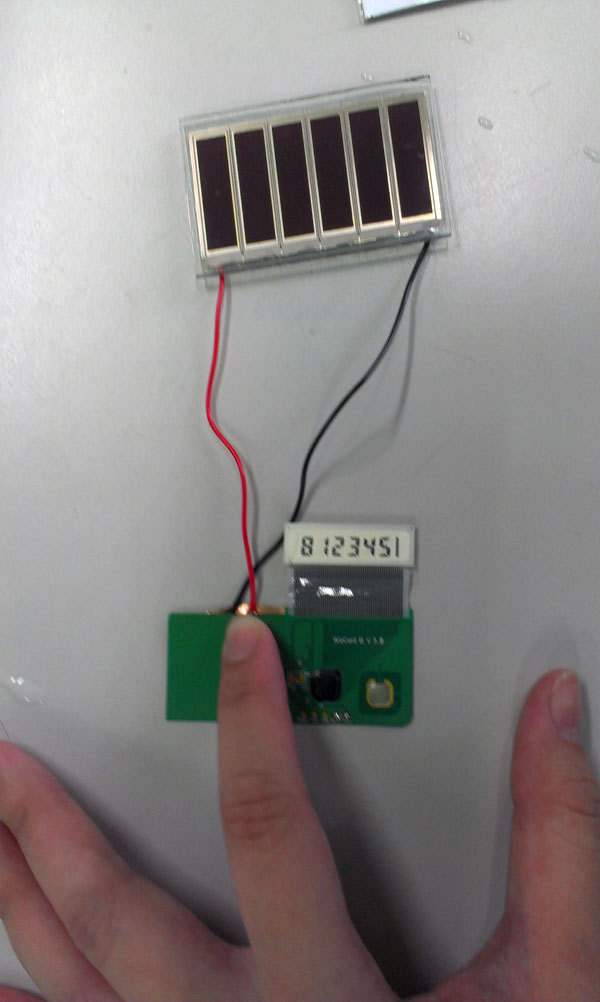
DSSC module successfully powering an electronic tag
Currently capable of generating enough electricity for low power devices, the DSSC is a viable solar cell technology that has ample potential to be one of the key answers to our planet’s energy crisis. For future research, Professor Su and her colleagues at the Molecular Science and Engineering Department along with their students are looking towards ways of increasing the efficiency of DSSC. To explore the effectiveness and the limitations of different materials, endless research possibilities will be created to test the structure of dye molecules and the morphology of semiconductor nanoparticles.
"The greatest obstacle in assembling the solar cell is to match the anode on one piece of glass to the cathode on the other piece of glass so current can pass through," said Akira Hsu (許雅淳), one of Professor Su’s students in the master's program. When asked what can be done to overcome the difficulties in her research, Akira expressed, “Constant practice is the only key!” Like many graduate students at Taipei Tech, Akira works endlessly each day to produce remarkable results in her chosen field.
Each department in Taipei Tech has its distinct purpose and area of specialty geared towards educating undergraduate students, and providing graduate students with necessary experiences for their future careers. In the five decades since the Molecular Science and Engineering Department was founded and with the Textile Engineering Department as its forerunner, the aim of the department has always been to recruit and train talented young minds with an interest in the applied chemistry of organic and polymeric soft matter. The Molecular Science and Engineering Department at Taipei Tech is the first department in Taiwan that combines the two molecular based academic disciplines together. With textile engineering as its foundation, the department took the science of molecules and expanded it into three interlinking educational programs: organic materials, polymeric materials, and textile fiber programs. These three programs explore the areas of green materials, photonics materials, bio materials, energy materials, nano materials, and textile materials from a microscopic level. The developments in these respective areas are all reliant on the applicability of the most fundamental research of molecular science and engineering.
The fact that the development in the applications of DSSC occurred in this department is no small coincidence. With a history of textile engineering, researchers in the Molecular Science and Engineering Department have a unique understanding of the properties and uses of dye that enabled their advancement in the research of DSSC. Only time can tell what other kinds of groundbreaking research would be presented to the world from the Molecular Science and Engineering Department at Taipei Tech.