If You Can Think of It, You Can Print It: The Wonders of 3D Printing
Rebecca Lynn Li
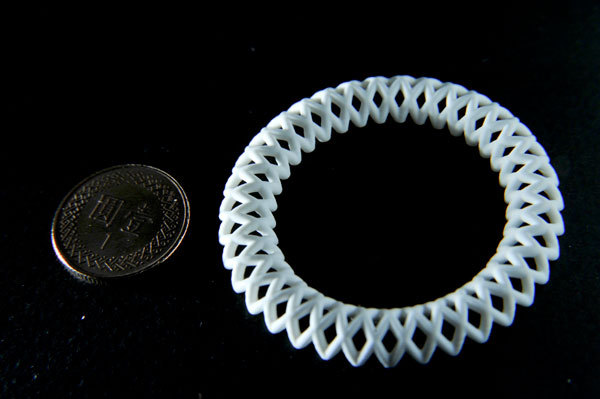
A small bracelet with intricate design next to a penny
The greatest gift that anyone can have is imagination. With that imagination, one can dream up all sorts of different things. However, being able to possess a model of one’s design isn’t as easy as it sounds. With all the materials available in the world, constructing a prototype is a daunting and tedious task, which can sometimes lead to unsatisfactory results. In the past three decades, an easier and more efficient way has been discovered: 3D printing. Very soon, if one can come up with a design, one can produce a model of it.
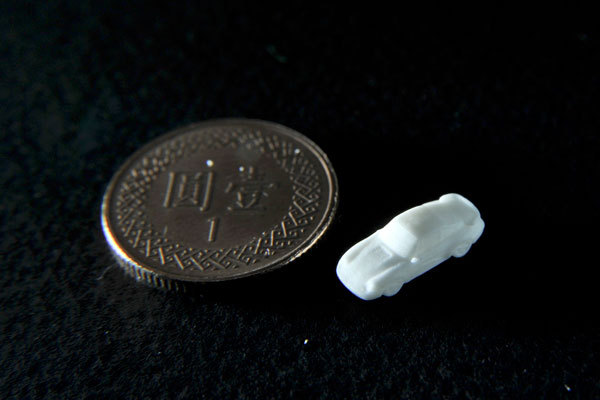
Miniature car next to a penny
3D printing, also known as additive manufacturing, generates three dimensional objects by successively adding layers on top of each other. One way of building these layers is to fuse layer upon layer of powder together with a laser; another way is to bind sheets of materials layered on top of each other. There are many different ways of classifying the technology of 3D printing, such as by the materials used to form the model, the way each layer is formed, and the way the thickness of each layer is controlled. However, the American Society for Testing and Materials (ASTM) boiled down the myriad methods into seven types. Of the seven types, Professor Jia-Chang Wang (汪家昌) of the Mechanical Engineering Department at Taipei Tech posits that Vat Photopolymerization, Binder Jetting, and Material Extrusion are the three types that are most suitable for development in Taiwan because Taiwan has pre-existing related technology.
Vat Photopolymerization uses a light source to selectively harden a vat of liquid photopolymer layer by layer. Similar to Vat Photopolymerization, Professor Wang’s method of 3D printing is called Solvent-Based Slurry Stereolithography and Sintering. With this technique, Professor Wang and his research team successfully printed many models complete with intricate details using very tough ceramic material. The greatest advantage of Professor Wang’s 3D printing method is not needing support structures when printing models with overhanging parts. In other words, there is no geometric limitation on the models that his method can produce.
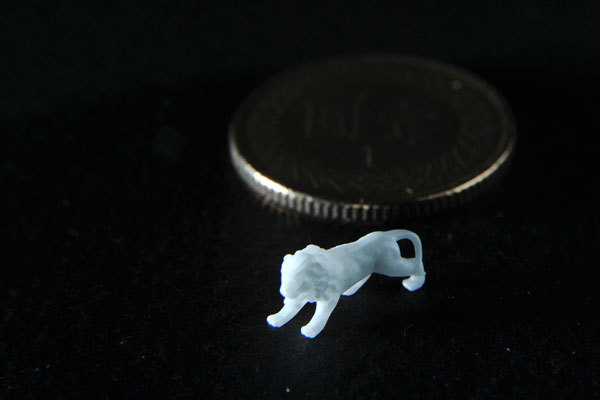
Miniature lion next to a penny
After completing many scans of a large wooden version, Professor Wang printed a miniature version of a lion figure approximately 1.2 cm in length, 0.3 cm in width, and 0.6 cm in height. The material is alumina, and the flexural strength is 470MPa. From the muscle on the body to the detailed lion’s mane right down to the lion’s tiny ears and the shape of its claws, the details on the lion are truly astonishing. With 3D printing currently able to print layers as thin as 0.02 mm, Professor Wang seeks to explore using different materials and strives to increase the stability of the printed result. Professor Wang explains that the most important thing in 3D printing is to ensure that no mistake arises when any of the layers is created.
The big question that people are asking about 3D printing is, where will this technology take us? While Terry Gou, Chairman of Foxconn, believes 3D printing is a gimmick, Professor Wang sees customization as the way to go. Instead of mass producing at a lower cost of production at a factory and selling globally, Professor Wang reasons that small locally owned businesses serving the people living in the immediate areas would be the initial step in future development. Professor Wang points out, “the greatest advantage in 3D printing is that no two printed results need to look the same.” 3D printing would be able to customize the product exactly to the customer’s preferred shape and design. To illustrate his point, Professor Wang brings up the fact that not everyone can find a pair of eyeglasses that fits perfectly, as the market only offers limited frame sizes. The solution could lie with 3D printing.
Since its initial development in the 1980s, 3D printing has made enormous strides and it has a great potential to be, as President Obama describes it, “Revolutionary”. Professor Wang, with remarkable achievements from his method of 3D printing, is continuously advancing towards the next big breakthrough. It won’t be long until the world knows what else the 3D printer can print.