Nobel Laureate Dr. Negishi Teaches Taipei Tech Students How to Succeed in Life

Nobel Lecture Series
Nobel Laureate Dr. Negishi Teaches Taipei Tech Students How to Succeed in Life
By Jenny Chen
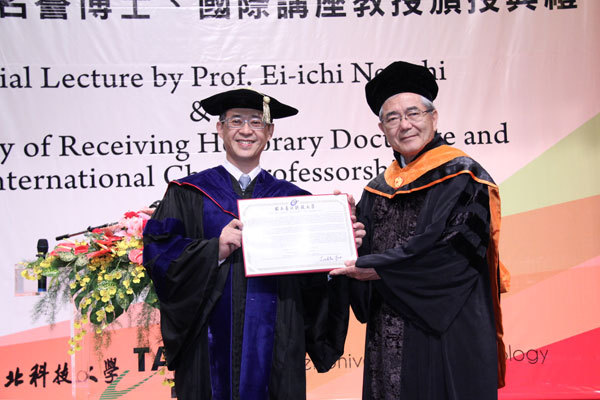
Dr. Negishi (right) receiving the Honorary Doctorate Degree from Taipei Tech President Yao (left)
Nobel Laureate and Taipei Tech International Chair Professor Dr. Ei-ichi Negishi spoke to students on Taipei Tech campus in December 2012 and shared his experiences and journey towards attaining the Nobel Prize.
Shortly before his speech, Dr. Negishi attended Taipei Tech’s Paradigm University Committee meeting, in which he advised the members to look towards becoming the best and compared our university with technical schools beyond Taiwan and Asia, such as MIT, Georgia Tech, and ETH Zurich, just to name a few. Becoming the best should be our standard and goal, and we should believe that we have the capacity to compete at an international level with the world’s best technical schools. Dr. Negishi also mentioned that since we already have a well-recognized electrical engineering department, the university can also start to look at putting more emphasis on our chemistry department. The chemical component of a technical school should not be sidelined as chemistry is the basis for many technological developments.
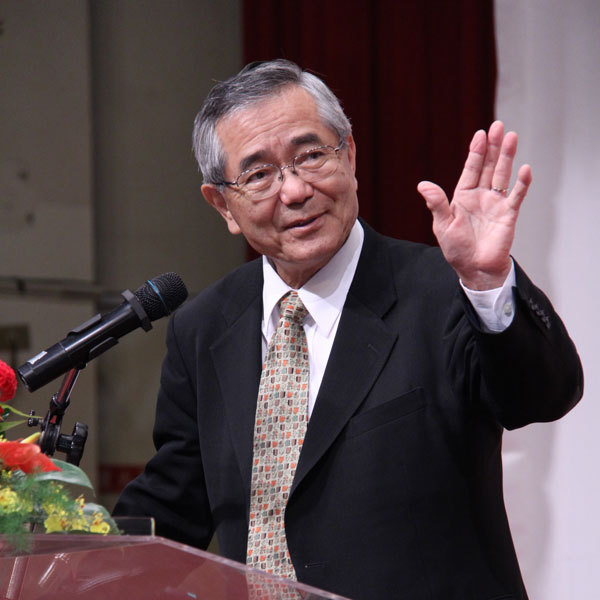
Dr. Negishi speaking to students at Taipei Tech
Soon after the committee meeting, Dr. Negishi made his way to the campus auditorium for his keynote speech, “The Nobel Journey through Chemistry – an intergenerational dialogue with Dr. Negishi”. The auditorium was fully packed with more than 200 students not only from Taipei Tech, but also high school students from Taipei First Girl High School(北一女), the Affiliated Senior High School of National Taiwan Normal University (師大附中), and National Panchiao High School(板橋中學). Dr. Negishi began his speech by encouraging everyone to find their passion in life and pursue it and reminded students that anyone can win a Nobel Prize. The combination of academic diligence and passion will be key to earning that success. Over the past 100 years, there have only been 1,000 Nobel Prize winners; the odds of winning are one in 10 million. But if every effort towards success is broken down into steps, one can reach the goal within 7 steps.
After graduating from university, Dr. Negishi went on to work in a polyester company. There was no one to teach him what to do; he had to be his own teacher. He soon understood that most companies usually put emphasis on application rather than theory. It was then that he realized that his knowledge was not enough; therefore, he went to further his studies abroad.
During his time studying in the United States, he met Professor Brown, who was the Nobel Prize winner for Chemistry in 1979. Professor Brown was a great mentor to Dr. Negishi; Brown taught him how to do research successfully, but not what to do research on. Dr. Negishi then adapted a method of “systematic exploration” for chemistry. Through his explorations, he found that palladium is a useful transitional metal that can work as a catalyst. Palladium can be expensive, but as a transitional metal catalyst it can be reused infinitely to reduce costs. It was this discovery of palladium-catalyzed cross-coupling that earned Dr. Negishi the Nobel Prize in 2010. He had created an influential tool for synthesizing a wide range of useful chemicals used in medicine, agriculture, and electronics. His ground-breaking work is now widely used in the industry and research studies in a variety of applications, including pharmaceutical antibiotics that work on drug resistant bacteria, agricultural chemicals that protect crops from fungi, and electronic light-emitting diodes used in the production of extremely thin monitors.
Dr. Negishi provided many good suggestions to both the improvement of Taipei Tech and to the growth of the students. In short, both Taipei Tech and its students need to strive for excellence and think of themselves as one in a million.