Air-conditioner Whale: Designed by student at Taipei Tech
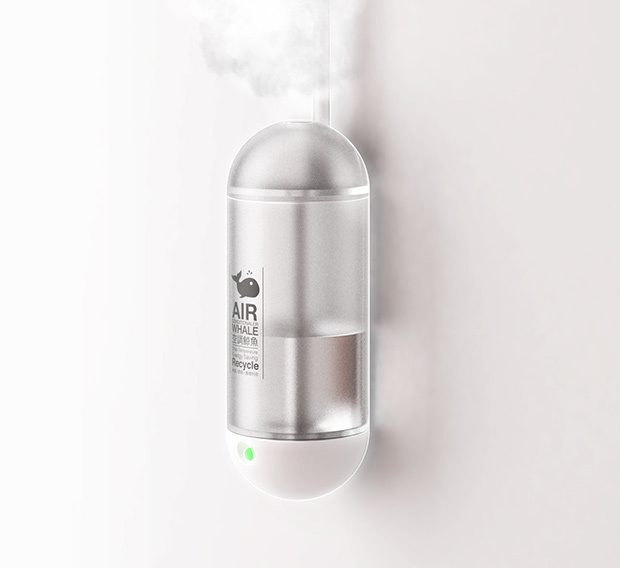
As global warming gets worse, usage of air conditioner surge in South Asia, Africa and countries around the equator. Air conditioners consume vast amounts of electricity and release more carbon dioxide, which contribute to the acceleration of global warming.
During operation, air conditioners produce a lot of water through dehumidifying and condensing the air inside. The water produced by air conditioner is relatively clean, and simply getting rid of it is wasteful. Adopting a simple design theory of “one gram of mist being evaporated naturally can reduce 539 Kcal,” the “Air-conditioner Whale” designed by Pei-chihTeng, student from the Graduate Institute of Innovation and Design at Taipei Tech, collects and re-filters the water produced from the air conditioner. After collecting water, the “Air-conditioner Whale” will transform it into mist. And by spraying mists to cool down the temperature in a room, it will greatly reduce the electricity consumption of the “fast cooling” function in a room that just turned on the air-conditioner.
Air conditioner also acts as a dehumidifier, which causes users who stay in air-conditioned offices or living spaces feeling dry and uncomfortable. “Air-conditioner Whale” detects the humidity of the space and sprays mists to maintain optimal humidity when air condition is on, allowing maximum comfort and efficient use of energy.
The “Air-conditioner Whale” was awarded Final List in Industrial Design Excellence Award and Winner in Red Dot Award for Design Concept 2015.