Department of Vehicle Engineering Leading the Way for Electric Vehicles
Rebecca Lynn Li
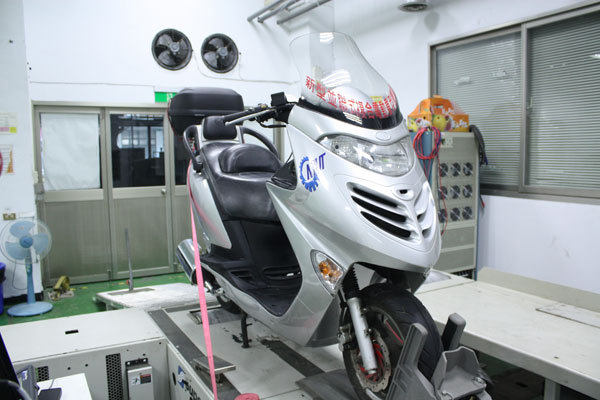
Hybrid electric motorcycle with inverse differential gear
"Help Taiwan's car industry come up with the next step!" said Professor K. David Huang (黃國修), Department of Vehicle Engineering Chair at Taipei Tech. Originally a part of the Mechanical Engineering Department, the Department of Vehicle Engineering was set up as an independent department in 1997. Esteemed faculty members provide interdisciplinary education, with emphasis on hands on experience to prepare students for a career in research or the job market. Following the megatrend of the car industry of producing intelligent, clean, and safe vehicles, the department shifted its focus from repair and maintenance to research on the frontiers of vehicle engineering.
The four features of the curriculum and research of the Department of Vehicle Engineering include Electrical Control, Design, Power, and Energy. The department’s interdisciplinary structure guides students to look at a system as an integrated whole, and understand how each part works in relation to the whole system in order to create value innovations. “Each one of our students is a car doctor,” states Professor Huang. Like the outstanding alumni working at managerial positions of major car companies such as Hotai Motor (和泰汽車公司) and Yulong Motors(裕隆汽車公司), many talented and skilled students are continuing to walk through the halls of the Department of Vehicle Engineering.
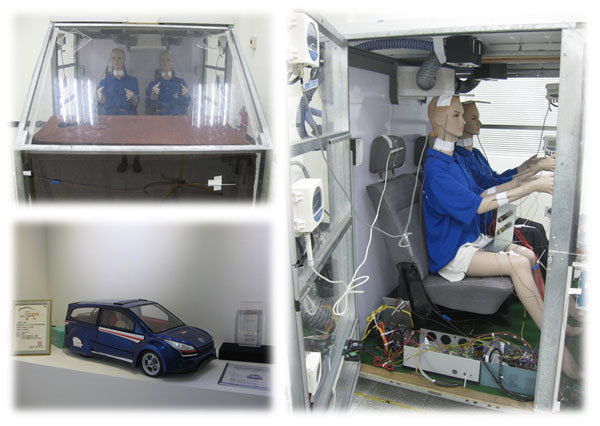
Specialized air conditioning system being tested with thermal mannequins to simulate body heat
Currently, one of the research studies conducted in the Department of Vehicle Engineering explores a new source of power for vehicles. Benson Sheng (沈大鈞), a second year master’s student, has been working on a hybrid electric motorcycle with inverse differential gear. This prototype has an integrated propulsion system comprised of an electric motor and an internal combustion engine. Capable of recapturing the energy lost when the motorcycle is coasting or breaking and converting the energy back to electricity, this motorcycle also reduces fuel consumption by 40% and emission of carbon monoxide and hydrocarbons by 50%. The patent rights for the development of this type of hybrid electric system is owned completely by Taiwan and by combining the motor and generator, there is a decrease in the complexity, cost of production, and weight and volume of the system compared to the existing technologies in foreign countries.
Sometimes, do you feel so hot in the car while everyone feels that the temperature is just right? Students in the Department of Vehicle Engineering not only research ways to make vehicles more ecofriendly; they also explore new user-friendly designs to implement in vehicles. Heat enters a vehicle in various forms such as sunlight, the heat of the engine, and heat of the exhaust. The air conditioning systems in vehicles today are sufficient enough to lower the temperature. However, Ken Song’s (宋彥勳) air conditioning system design goes beyond just controlling the temperature; he controls the wind speed to maximize the comfort of the passengers. Ken strives to separate and keep constant the currents of air felt by each passenger in the car so each individual can adjust the thermostat to their preferred temperature. In his simulation of a vehicle, Ken attached thermal couples to the mannequins to simulate body heat, set up high power lamps to simulate sunlight, and used vapor in order to see the flow of the air current.
Currently carrying out cutting edge research and producing remarkable results aptly demonstrated by these two students, the Department of Vehicle Engineering is well on its way to revolutionizing the car industry.