Taipei Tech Team Develops Advanced Green Energy Fuel Cell
By Jenny Chen |Secretariat Office
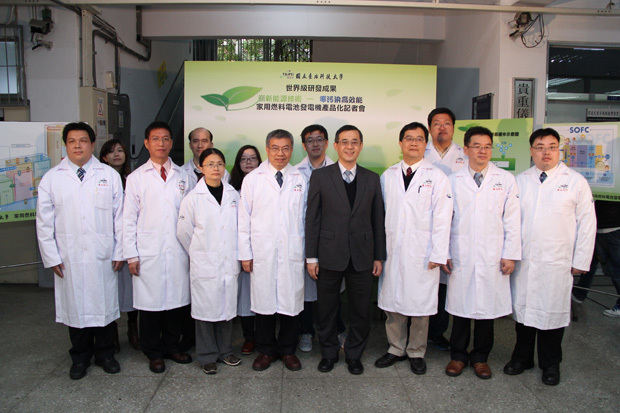
Taipei Tech Pres. Yao (center), Taipei Tech Vice Pres.
Wang (4th to left) and Dr. Thomas CK Yang (3rd to right)
with members of the SOFC development team.
In steps with the school vision of being a green university, the Taipei Tech research and development team, led by Taipei Tech Vice President Wang, announced a new kind of green and sustainable fuel cell. Following closely behind the US, Australia and Japan, Taipei Tech has also successfully developed a much more efficient and green fuel cell for household use.
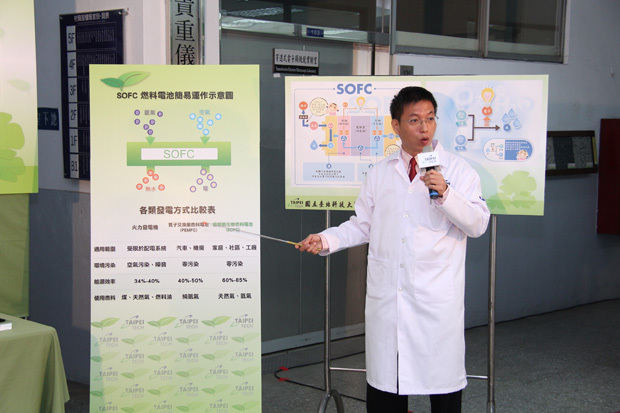
In steps with the school vision of being a green university, the Taipei Tech research and development team, led by Taipei Tech Vice President Wang, announced a new kind of green and sustainable fuel cell. Following closely behind the US, Australia and Japan, Taipei Tech has also successfully developed a much more efficient and green fuel cell for household use.
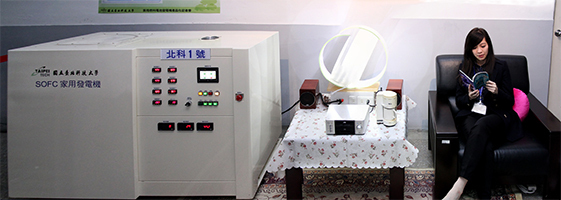
The size of the SOFC can vary depending on one’s need. It can be conveniently sized for remote locations that electric wires do not reach to. A properly sized SOFC can produce enough electricity to support a factor or even a small community. Another advantage is that the SOFC can generate power 24 hours a day, 7 days a week; a characteristic unlike other green fuel cells that are restricted to solar and wind power.
SOFC research and development team leader, Taipei Tech Vice President Wang also stated that “Due to the greenhouse effect caused by pollutions, more countries and institutions are leaning towards a greener solution for electric power. Therefore the importance on the development of a green SOFC is gaining dominance.” Vice President Wang also pointed out that compared to other countries’ high temperature fuel cells, Taipei Tech’s SOFC is categorized as medium temperature. As a result Taipei Tech’s SOFC is more efficient at energy conversion.
Taipei Tech’s SOFC was domestically produced; everything from materials to assembly was done in Taiwan. In addition, household SOFC can be commercialized in the near future. This shows that Taiwan already has the advanced technology and technique to export these SOFC batteries. Thus, this new mechanics has a large market potential for economic growth as well.