Honorary Doctorate Given to Vincent Siew, Vice President of Taiwan
Office of Secretariat 2012.05.01
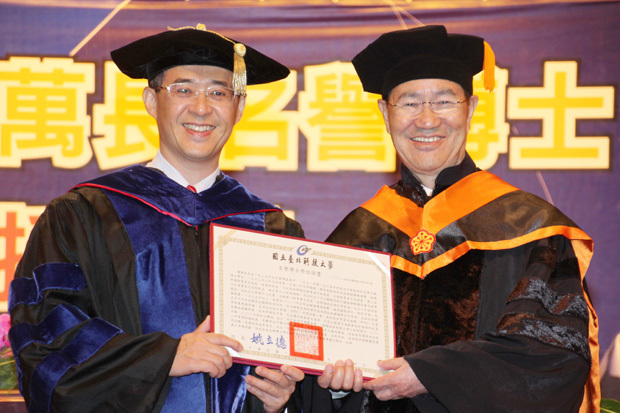
In recognition of Mr. Siew years of devoted public life, TAIPEI TECH honoured him with an honorary doctorate. Mr. Siew officially became one of the alumni of TAIPEI TECH.
The Vice President of Taiwan, Mr. Vincent C. Siew, was awarded an honorary doctorate degree by TAIPEI TECH on April 24th, 2012.
Mr. Siew originally received admissions from both Provincial Taipei Institute of Technology (later to become TAIPEI TECH) and National Chia-yi Senior High School 57 years ago. Owing to problems of distance and the location of the two institutions, he accepted the latter which was near his hometown.
Having graduated from college, Mr. Siew began his extraordinary life of public service. He devoted more than 50 years of his life to this service. He has held many significant positions: the Economic Affairs Minister of Taiwan from 1990 to 1993, Premier of Taiwan from 1997 to 2000. He is presently the 12th vice president of Taiwan from 2008.
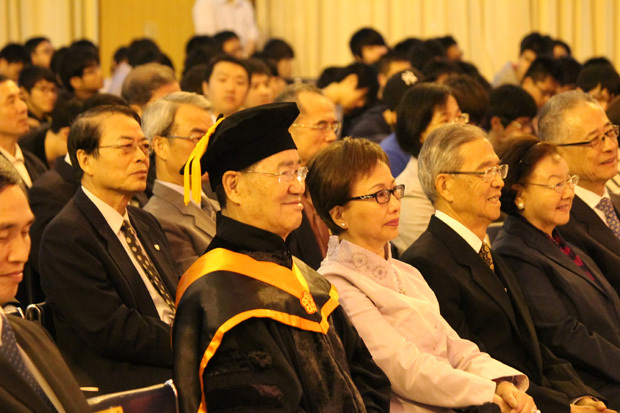
On the day he was awarded his degree, many important people were present. They included the Minister of Economic Affairs, Dr. Yen-Shiang Shih; Political Deputy Minister of Education, Dr. Tsong-ming Lin; and over 2,000 students of TAIPEI TECH.
In other words, the Taiwanese people must learn the skills of innovation and be prepared to change. “Our country should direct its energy towards creativity, oriented to meet the world’s need”. He pointed out two examples, one from his personal experience. Being a cancer victim himself, he stressed the importance of not giving up hope, of adapting.
Once he went to inspect farms and fields. He found out that farmers and traders had adapted to a changing world, and developed new management strategies. They combined growing crops with the latest technology, boosting their productivity. In addition, they marketed their products on-line, a very innovative approach. This is a model of management in the agricultural industry.
The other example was inspired by Eslite Book-store. Traditionally, book-stores among Chinese people in China, Hong Kong and Taiwan were running at a loss. However, Eslite Book-store thought and managed differently. It combined aesthetics, fashion, taste, and competencies of humanism with the idea of a book-store. It therefore established a new and successful model for the industry.
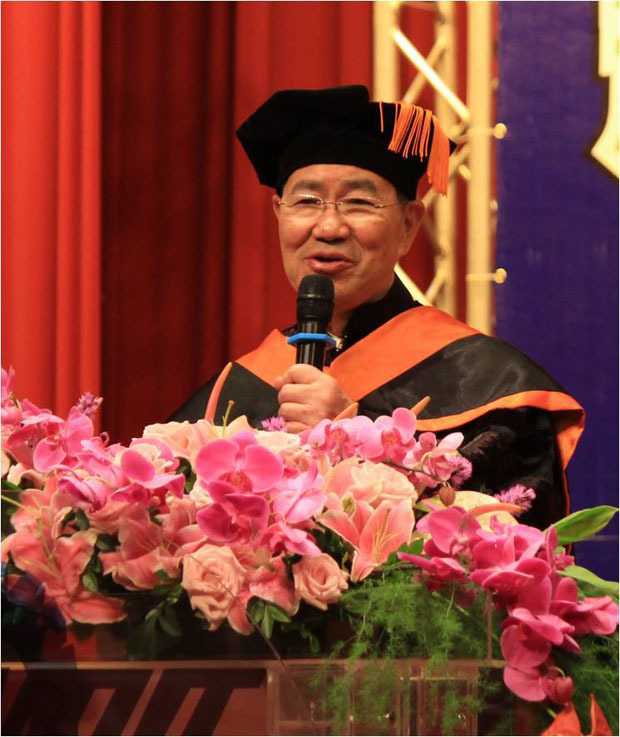
Mr. Siew summed up the speech with the expectation for TAIPEI TECH becoming the pioneer in this transforming trend. He hoped that TAIPEI TECH could integrate the past glory of Taiwan with a promising future and combine the successful traditions with unlimited creativity.
Mr. Siew further indicated in the critical comparison of the Gross Domestic Product (GDP) between Taiwan and Singapore. Taiwan spent 19 years to grow from 10,000 USD to 20,000 USD, compared to 5 years in Singapore. The key to Singapore's growth lay in the development of creativity and innovation. Consequently, this was the road that Taiwan should take.
He also urged the University to embrace the global community and develop solid academic‐industry collaboration. Hence, the university could contribute more to society and the country in terms of economic expansion and technological development.
Above all, TAIPEI TECH could earn the reputation of being an innovative technological university with its own unique features and specialities.