Carpentry on Campus
Oscar Chung
(Excerpted from Taiwan Review)
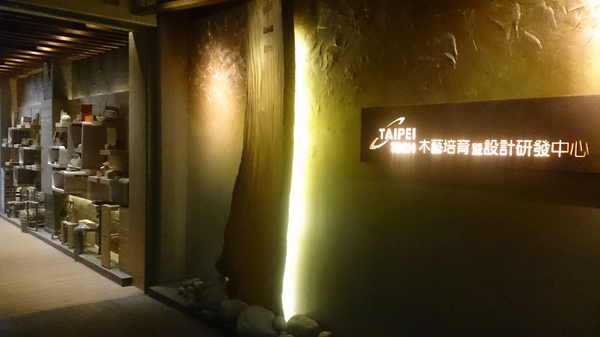
The Woodworking Training Design Research Center on Taipei Tech campus
As the leader in technical and vocational tertiary education in Taiwan, National Taipei University of Technology (Taipei Tech) in Taipei City is playing a key role in the emerging trend to nurture talent in carpentry. The ambition of the university to help revive the trade was mainly fueled by a newspaper story Yao Leeh-ter (姚立德), the president of Taipei Tech, came across last year. It was about an old carpenter in southern Taiwan bemoaning the decline of the vocation and expressing his wish to fund a school to reverse the trend. Deeply touched by the story, Yao vowed to realize the carpenter's dream through the formal education system. For years the MOE has commissioned Taipei Tech and other technical universities in Taiwan to provide junior high school students and their parents with information and guidance on vocational education. Taipei Tech has also encouraged technical colleges and universities to evaluate the vocational and technical skills of freshman students during the recruitment process. Now the university is promoting education in technical skills, which the school hopes will prompt a resurgence in the carpentry industry.
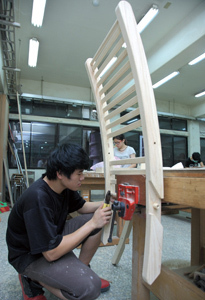
Students learning carpentry skills at the Woodworking Training Design Research Center
on Taipei Tech campus
These efforts involve establishing a trade cluster where carpenters will be encouraged to accumulate hands-on experience as they learn and work together. They will even be able to earn a master's degree in the field, which will be the first of its kind in Taiwan. Officially announced in late May this year, the Wood Arts Creative Park in Dongshih District of Taichung City, central Taiwan, is a joint effort by Taipei Tech and Yuen Foong Yu Inc.; the university is providing the teaching staff, while the paper manufacturing company is providing the land, resources, and spaces converted from decommissioned factories. "Young people rely a lot on the Internet to gain knowledge and develop creative power, but this park will enable you to use your hands to actually create things," says Taipei Tech Secretary General Thomas Yang (楊重光). "People talk about creativity and design skills all the time, but there is a lack of hands-on experience. This produces a gap between a good design on paper and the product that you actually can make according to the design," Yang adds, explaining the significance of the park's inception.
Cultivation of creative human resources is the park's top task. There will be training courses in carpentry for interested people at different levels of proficiency. Master's degree seekers will be able to enroll in a program that will allow them to hone their carpentry skills while also acquiring knowledge in other areas such as managerial know-how. Yang says that the program will be launched in just two years, noting that Taipei Tech is very experienced at opening programs that target specific sectors in this manner, which helps develop human resources that are equipped with highly specialized knowledge.
Taipei Tech has long offered carpentry education as part of the curricula in the Department of Industrial Design and Graduate Institute of Innovation and Design. In the hopes that a revival of the trade will soon take root, Taipei Tech have taken steps to promote carpentry in higher education by building the Dongshih park and offering a master's degree program in the field. "Representatives from various related sectors came to attend the official announcement of the park, from the wood processing industry to wooden toys manufacturing. They feel greatly inspired by the park's birth," Yang said.
Yang notes that Taiwanese society still tends to value scholastic achievements over technical skills. "The vast majority of junior high schools in Taiwan still encourage their graduating students to go to senior high schools offering standard courses," the Taipei Tech official says of his experience interacting with school authorities around Taiwan. "And that's because Taiwanese parents want their children to go to a standard senior high school instead of a vocational one."
With the establishment of the Wood Arts Creative Park, Taipei Tech's Yang has good reason to anticipate a rosy future for Taiwan's furniture and woodworking industries. "Hopefully Taiwanese operations in the industry that moved abroad seeking cheaper labor will return to take advantage of local talent, whose creativity is only growing," he says. In the long term, he says, a domestic furniture brand that caters to global demands in the manner of Sweden's IKEA could be established in Taiwan. Starting with the boost from formal education that carpentry has received at a few schools, a renewal in the field may emerge in Taiwan that provides not just a wealth of woodcraft to the nation and the world but a growth in related industries that can help invigorate the country's economy and increase employment.